


Sunday, November 27, 2005
Basement Cup 2006
It's been six years since we've had a basement space suited to indoor soccer. Don't worry; it's not the nicest part of the house. On second thought, maybe it is.
Ph. and I just battled through two grueling matches to seven.
Saturday, November 26, 2005
Wall Street Journal, A6
Kevin Delaney's article, "Big Mother Is Watching: Tailing Teens on the Web," ran today on the front page of the Wall Street Journal. It reports on teenagers, families and weblogs--the blurring of public/private mixed up in self-publishing for the variously scaled publics of the web. Sure, the article's premise brushes with the criminalization of teenagers and the stepped-up police-parentals when adolescents take to blogspace (surveillance, spying, etc.), but it balances out in that blogs are never assigned the total burden of responsibility for teenage underlife. Probably won't register even faint trace on the public intellectual-o-meter, but I'm quoted in the article (one-plus inches, fourth column). And the best part: rather than shaking my fist and cursing the danged kids with their wily wiredness, I had something optimistic to add.
Missed it? You can still get a copy at the newsstand tomorrow for $1.50 (weekend edition).
Added: Full text of the article available here.
Friday, November 25, 2005
Exhousted
There: we're finally living in the new neighborhood. The boxes and plastic bins were heavy; the furniture, we loaded it onto the U-Haul truck despite persistent flurries throughout the day on Wednesday (Ph. was great about sweeping the loading ramp between items). With just a few small remnants left back at the old apartment, I'd say we're fully and finally moved in. Did you know U-Haul leases their crappiest trucks for local moves? It's true. Odometer showed over 181-thousand miles, and the cargospace was filthy (plus, broken tail light); nonetheless, it managed to chug herky-jerky-like through the streets of E. Syracuse (no more than a total of a few miles by the time we had it returned to the store).
My latest favorite instrument: the appliance dolly. The controlled-turn belts on the back of the dolly prevented the injuries and severe fatigue I would have surely endured without the device. Because the belts lock after each step-down, I repeatedly avoided the part I envisioned over and over where I slip and tumble helplessly into a sprawlform of bruised and broken extremities.
Present plans: A restful evening (not that yesterday wasn't restful; it was...but the drive home was, uh, very very snowy...torment-by-blizzard, foot-per-hour snowy for the first 20 miles or so). With proper motivation I'll be back to deep and intensive bookishness tomorrow and Sunday--a more focused read-n-write routine.
Oh, and you should pick up a copy of the Wall Street Journal tomorrow. There'll be an article in it about weblogs. I haven't read the story yet, but I'll try to say more about it once I do.
Tuesday, November 22, 2005
Fr. Basketball
A couple of folks have expressed interest in Ph.'s schedule. Here it is. The first home game tips off later today.
05-06 Schedule
11/18 @ Baldwinsville, W, 52-50 OT
11/22 West Genesee (HWSmith), W, 64-63
11/29 Liverpool Orange (N'ham), L, 43-40 OT
12/6 Rome (N'ham), W, 62-20
12/8 @ Central Square (Millard Hawk), W, 53-50
12/13 @ Fowler (Frazer), L, 56-55 OT
12/15 Corcoran (HWSmith), W, 50-48
12/22 @ Liverpool Blue (Annex), L, 55-49
1/4 @ Henninger (Levy), W, 54-47
1/6 Fayetteville-Manlius (N'ham), W, 52-39
1/10 Baldwinsville (Levy), W, 61-47
1/1213 @ CNS (NSJH), W, 53-46
1/17 @ Auburn (Auburn), W, 53-49
1/19 Henninger (Solace), 4:00 p.m.
Overall: 10-3
Among the Shortcomings of New Media
New media is no help with
- forming a voting bloc when the family is reduced to democratic channel-flipping. Texas vs. West Virginia or crappy sitcom re-runs? I could've used another vote, NM.
- packing and taping boxes.
- carrying and loading boxes, furniture.
- unloading and carrying boxes, furniture.
- diffusing the weather system set to deliver several inches of fresh snow while we dollycart the heavy stuff into a truck (drive...drive) and then into the new pad.
- delivering Ph.'s socks to the office in time for the start of gym class.
And, uh, these aren't my notes on Manovich. I'll have those up v. soon, however (end of the week?).
Friday, November 18, 2005
A/Curdity
Defn.: hefting a pair of lead-heavy window air conditioning units through thirty-degree temps and snow squalls into a house equipped with central air. Slick sidewalks! A/Curdity. That's my new word for today. No, we don't have a pressing need for the air conditioners, but nobody's seeking window AC-units in Syracuse in mid-November. Plus, they're good social insurance--guarantees that I'll have a way to make new friends in June when it's back to 90-degrees F and 80-percent humidity. So I'm trying to focus on airconditional friendship while shuttling those units and other stuff this AM.
Wednesday, November 16, 2005
Hansen - New Philosophy for New Media (2004)
The foreword by Tim Lenoir, "Haptic Vision: Computation, Media, and Embodiment in Mark Hansen's New Phenomenology," lays out groundwork on the "deterritorialization of the human subject" in terms of digital media, detachment and problems of reference. Lenoir touches on Hayles' account of post-humanism (also Bill Joy's "Why The Future Doesn't Need Us"), Shannon & Weaver's signal-based model of information, and Donald McKay's alternative communication model. Overall, it's more than a worthwhile thumbnail of Hansen's project in the context of other works only semi-familiar to me: Kittler's Gramophone, Deleuze's Cinema 1 & 2:, and Henri Bergson on the body as image:
The body is itself an image among other images--in fact a very special kind of image Bergson calls a "center of indetermination," which acts as a filter creatively selecting facets of images from the universal flux according to its own capacities. The body, then is a source of action on the world of images, subtracting among external influences those that are relevant to its own interests. Bergson calls such isolated image components "perceptions." (xx)
Lenoir's foreword solidly marches us through the conceptual surrounds to Hansen's concerns with embodiment, enframing and the relationship of image and body which has been redefined by digital technologies. I keyed especially on the notion of post-medium, something Lenoir critiques as an extreme position from Kittler: post-medium--"when media disappear into information flow, when information no longer needs to adapt" (xvii). Affect is central to Hansen's project, and so it makes sense, given this contrast with the idea of post-medium, that Hansen would extend Bergson's stance with emphases on vision, touch and self-movement: body and image. The sharpest part of the foreword comes near the end with the discussion of affective cognition. According to Lenoir, "affect provides the bond between temporal flow and perceptual event" (xxv). Summarizing neurophenomenologist Francisco Varela, Lenoir notes "that affect precedes temporality and 'sculpts' the dynamics of time flow" (xxv). Taken to questions about the visceral interaction between body and image, these affectively sculpted dynamics transform the "thresholds of the now" incumbent to new media.
Well yes of course, and there is the part of the book by Hansen. Introduction (1-15): When aura, as from Benjamin, vanishes (or rather submerges into the dull wash of commonplaces); when, as Rosalind Krauss might argue, the post-medium condition has burdened us with "the possibility for the universal and limitless interconversion of data" (2); and when, as Kittler might contend, "digital convergence promises to render obsolete the now still crucial moment of perception, as today's hybrid media system gives way to the pure flow of data unencumbered by any need to differentiate into concrete media types" (2), we need not to surrender the body to these seemingly dehumanizing forces. Hansen asks, "Will media matter in a digital age?" (1). We might find in his project an affirmative response, one that, by involving Bergson's Matter and Memory, establishes the body as a kind of medial nexus: "the body functions as a kind of filter that selects, from among the universe of images circulating around it and according to its own embodied capacities, precisely those that are relevant to it" (3). Perception is always embodied, then. The body becomes an affective aggregator, inevitably selecting among (a plenitude of possible) perceptual experiences and leaving out the rest. The enframing body wreaks havoc on idealized, ocularcentric notions of frame: "Beneath any concrete 'technical' image or frame lies what I shall call the framing function of the human body qua center of indetermination" (8).
In chapter one, "Between Body and Image: On the 'Newness' of New Media Art," (21-46), Hansen argues that "the body's centrality increases proportionally with the de-differentiation of media" (21). We experience variously encoded realities (physical, virtual, hallucinatory), and we experience, in the digital era, changes in the "body's scope of perceptual and affective possibilities" (22). New media embodiment stands (if hologrammatically?) among such realities and possibilities. Specifically, Hansen critiques art historian Rosalind Krauss and media studies scholar Lev Manovich. Krauss's "pulsatile dimension," which she applied to Duchamp's Rotoreliefs and James Coleman's Box (on Tunney-Dempsey boxing) which involve the viewer's body in the "filmic fabric" (28), privileges the work over the body and thus it isn't quite adequate to account for the aesthetic (synesthetic?) experience of projects such as Douglas Gordon's 24-Hour Psycho (Hitchcock's film at a "disjunctive" two frames per second (29)) and Paul Pfeiffer's The Long Count. The bulk of the chapter turns critical attention to Lev Manovich's The Language of New Media. Hansen sees Manovich's reliance on film as overwrought--too dependent on models of cinema-frame-image that bear out culturally and historically, confining the "polymorphous possibility" of the digital image (35). Hansen also regard Manovich's discussion of VR as privileging the physical to the representational, a mistake which is even more glaring in consideration of the telepresence interface (40) (simulators for surgery, etc.). Manovich's work, ultimately, is too cinematically determined, according to H.
Quotations
"All forms of cognitive act arise from coherent activity of subpopulations of
neurons at multiple locations" (xxiv).
"The philosophical problem [Bergson] faces is how to reconcile the specific
aggregate of images that appears to my body functioning as such a center of
indetermination and the aggregate of images that comprises the universe as a
whole... (4)
"Affection of affectivity is precisely what differentiates today's
sensorimotor body from the one Deleuze hastily dismisses: as a capacity to
experience its own intensity, its own margin of indeterminacy, affectivity
comprises a power of the body that cannot be assimilated to the habit-driven,
associational logic governing perception" (7-8).
"Correlated with the advent of digitization, then, the body undergoes a
certain empowerment, since it deploys its own constitutive singularity
(affection and memory) not to filter a universe of preconstituted images, but
actually to enframe something (digital information) that is originally
formless" (11).
"As I see it, the reaffirmation of the affective body as the "enframer"
of information correlates with the fundamental shift in the materiality of
media: the body's centrality increases proportionally with the
de-differentiation of media" (21).
"Far from being the source of a reductive unification of diversity, the body
is the very place where such diversity can be retained in a nonreductive
aggregation. As such, it is itself an integral dimension of the medium"
(25).
"The body, then, impurifies vision constitutionally, since, as Krauss points
out, there would be no vision without it: like the affective dimension of
perception, the corporeal holds a certain priority in relation to vision" (27).
"Because digitization allows for an almost limitless potential to modify the
image, that is, any image--and specifically, to modify the image in ways that
disjoin it from any fixed technical frame--the digital calls on us to invest the
body as that "place" where the self-differing of media gets concretized" (31).
"Recent phenomenological and scientific research has shed light on precisely
how and why such manual, tactile stimulation functions as "reality-conferring"
in the sense just elucidated. Phenomenologist Hans Jonas, from whom I borrow
this felicitous term, has shown that the disembodied (and hence, supposedly most
"noble") sense of vision is rooted in an and dependent on touch for its
reality-conferring affective correlate" (38).
Figures: Benjamin (1), Bergson (4), Deleuze (6), Manovich (9), Krauss (23), Duchamp (26)
Terms: extended mind (xx), movement-image (xxii), machinic vision (xxiii), haptic (xxiii), embodied perception (4), time-image (6), body's framing function (8), philosophemes (25), ergodic (39), hallucination (41), cinematic metaphor (42), visual-bodily cross-mapping (39)
Monday, November 14, 2005
Bulldog
Besides playing with "The Family" interface at Nike.com (via), this entry's just making it official that Ph. got word today he survived the final-final cuts and will be squeaking and streaking the hardwoods for the NHS freshman hoops team this winter.

Just got an email from the parent of a player on the old squad, too, telling me that seven former Stampede players made their respective teams around KC. It's immodest of me, I suppose, to bring that up, but we put in a grueling lot of work over four years, so the coach in me is mildly affirmed that many of them stuck with it.
Tingle and Self-Development
Nick Tingle's Self-Development and College Writing (2004, SIU Press) proposes a psychoanalytic stance on the "transitional space" of the composition class. Tingle's argument leans heavily on Robert Kegan's five orders of consciousness--a quasi-Piagetian theory of stage-based psychological development. Phase one accounts for ages 2-6 (which, taken literally, suggests pre-birth through the first twenty-four months of life are non-conscious...discuss). Tingle explains that some of the discord felt between teachers and students can be attributed to our varied developmental positions. College-level writing students, in Tingle's framework, match up with the third order of consciousness (16), which is often defined by institutional forces and tends to celebrate subjectivity (as in adolescence). The fourth order in this model accords with "'a qualitatively more complex system of organizing experience'" (16); it is a more sophisticated order of self-truth that "somehow break[s] the identifications of the self with its social roles" (17). Tingle writes that the modern university is designed to support students' movement from the third to the fourth order of consciousness, but because such moves involve destabilization and "narcissistic wounding," the writing class might function to enable and support. Furthermore, writing teachers are often positioned at the fourth order of consciousness (if not the fifth, which he correlates with postmodernism (20)). Teachers, therefore, must attend to their own stage-orientation when defining viable writing projects and articulating developmentally-appropriate expectations. It can prove disastrous, in other words, when fourth-order teachers presuppose their third-order students to be more psychologically advanced. Among the consequences: shame, embarrassment and humiliation (89).
In his discussion of selfobjects (citing Heinz Kohut)--"a person, place, thing or activity that is conducive to a person's sense of psychological stability or centeredness, no matter how momentary or provisional" (8), Tingle seems to be arguing for a more permissive relationship to language than is commonly available, a relationship supportive of students' affective attachments to selfobjects. Explicitly questioning selfobjects can be unsettling, and this unsettling happens across the university curriculum. It should be undertaken with considerable caution, according to Tingle.
After he frames the psychoanalytical theories to support his project, Tingle works through a series of specific applications in chapters 2-4: an anxiety-producing unit on biodiversity through which students struggle with scientific discourse (c. 2), a critique of Donna Qualley (self-reflexivity) and David Bartholomae (transitioning into the academy) on the grounds of becoming what you are not (there are psychological implications, T. explains, and he doesn't accept that entering the academy requires one to conform, to parade false selves (c. 3)), and a lesson he learned about allowing for affective attachment and subjective responses from students in a writing assignment he devised around Stoicism--specifically Epictetus' The Enchiridion (c. 4).
So far, I've tried only to describe what Tingle does in this project rather than my response to it. We're reading it for a course in methodology, and, depending on the degree of generality, I can imagine saying that Tingle is doing several ambitious and complicated things at once. In simplified terms, one question, I would say, stems from his interest in the breakdown between teachers and students (why do they write lousy summaries? (c.2), why do teachers feel personally slighted when students bash selections for reading? (c. 3), and why would a student revert to the safe domain of personal anecdotes and highly subjective/personal claims following more a more daring critique of assigned reading? (c.4)). Each of these anchors a chapter in this short book, and I would say that Tingle does reasonably well to develop thoughtful and instructive ways of responding to each question making use of psychoanalytic theory. The book closes with clear emphasis on allowing and encouraging the use of "I." My struggle in all of this, however, is that I'm skeptical of the orders of consciousness. They're just too clinical, too diagnostic, too teleological and too classificatory to hold up when we broaden the lens on development to a more varied group of students or when we open onto the blended developmental domains enveloping the institution. What if, for instance, students of the fifth order are mixed in with students of the third order? What happens when those teetering between orders 3 and 4 interact with others who are clinging--the result of recovering from destabilization--to order three? Or when a batch of essays comes in, some from consciousness 3.0 and some from consciousness 4.0?
I don't want to go too far with negative responses, but I do want to leave a few crumbs on the trail suited to later retracing. I wondered about micro-development and developmental error (what constitutes a full shift from 3.0 to 4.0? is the shift ever complete? are we constantly waxing between orders of consciousness? or is the most agile consciousness symptomatic of 5.0--pomo?). I also thought about Tingle's use of embodiment and the new media notion of enframing (bc I'm looking at Hansen right now too). And I thought the project tipped cynical on technologies (8, 149) and also on the developmental aspects of recreational facilities (152).
A few terms: extrospection (63), transitional space (4), extreme transition (48), academic irrelevance (149)
To end, here are two passages that I found interesting for different reasons. Again because I'm simultaneously reading into Hansen, the idea of tour-able objects sparked a few ideas. Digital images, enframing and the body's indeterminacy (as the nexus where all information is contending, I guess?) all twist the real/imaginary distinction set up here, in Tingle's summary of Sartre:
In The Psychology of the Imagination, Sartre argues that we are able to take a tour of a real object. I see this tree as a real tree and am aware that I am situated relative to it so that I can see only one side of the tree; to see the real thing, I must tour it and walk around the tree. As I walk around the tree, I see it as a series of profiles. Moreover, relative to the real thing, as we tour it, Sartre says, we may experience surprise. We may be surprised for example that one side of the tree has been struck by lightning or another side covered with moss. The real object Sartre contrasts with the imaginary object, a "tree," say, constructed in imagination. One cannot, he says, be surprised by an imaginary object; further he argued one can learn nothing from an image, because our knowledge of it is there all at once and put there by our imagination (8-14). (71)
And this, a passage of student writing cited by Tingle reminded me of Sirc's bread-only comp. Stuffed birds...heh. Reading Freire with the children of bankers. Oy.
I know you [the teacher] think Freire is hot stuff and has something to say or otherwise you probably wouldn't have assigned it. I, however, think what he has to say sucks. Everything he says and most of what you said in class too suggest to me that all of the education I had in high school was a waste of my time. I have been stuffed like a little birdie. Well, I wonder what Mr. Cranston, my favorite teacher would have to say. He was a good guy and not a bird stuffer. As far as I am concerned, Freire is insulting Mr. Cranston. Don't get me wrong. I am not going to say any of this (mostly because I am not conscious of any of it). I am going to try to write your damn essay and I will "respond" to Freire but I am going to do it my way. Oh, and by the way, my father is a BANKER. (87)
Sunday, November 13, 2005
Deepvember
Maybe tomorrow I'll get motoring with the blog again. We handed in the lease and deposit in exchange for keys to the new place yesterday mid-day. Instead of rushing home to pack boxes and get on with toting the first tiny loads of stuff, we rode out to Green Lakes State Park for a walk around the deep green water. Later on, Ph., filling in for a friend with a broken arm, played an indoor soccer match. Full and busy, this weekend. Over the next ten days I'm going for the slow-food variety of moving--slow-moving, carting a couple of loads each day, beginning with books.

Besides the move, I don't have any reason not to blog, so I'll be forthcoming with entries on Tingle's Self-Development and College Writing and a few pieces of Hansen's New Philosophy for New Media.
Thursday, November 10, 2005
Breakfast Theory
A few remnants for 691: Theory as method: Reid's 1989 cartoon, "Breakfast Theory: A Morning Methodology."

And for daily fiber: PBS Kids' Freaky Flakes. P'shoped a EWM-brand box. Plus, this, from the Detroit News, an article on Kelloggs. Elsewhere Homi Bhaba talks about breakfast cereal and globalization.

You know, spring of my senior year in high school, I had a basketball tryout at Kellogg CC in Battle Creek, MI.
Earlier today on ESPN News (playing low in the b'ground), the anchor, commenting on Jason Kidd's off-the-backboard oop to Richard Jefferson in the Nets-Jazz game last night, said (about connecting up on the fast break) "That's just good writing there."
Talks
Before a full week cycles around, I wanted to tack up a few notes about the Digital and Visual Rhetorics Symposium hosted at SU last Thursday and Friday. Each of the talks was stimulating/evocative; w/ these notes: I'm going for a patchwork of what was said and what it got me thinking about (highlights plus commentary). Fair enough?
"Documentary as a Hodos: A Public Counterpedagogy"
Jenny started with an explanation of public non-places, the spaces we pass
through out there that are so common-place as to be routine. As a counter to
these non-places and the "worldless
lessons...built into these walls," J. sought to complicate the widespread
lessons about monolithic, unchanging contexts, which she built up through a
series of examples and called a "pedagogy of delocalization." One
response, or a meta hodos (alt- ways, met-hod): create a
counterpedagogy. The counterpedagogy entertains the none-too-simple
question, "How did we get here?" How did we get here? J. explained
that mobilizing this question--enacting it? acting as if it's
answerable?--involves something more than reading texts about the conditions
giving rise to globalization, delocalization (although we can imagine the pedagogy
that studies how did we get here while keeping the classroom delocalized,
generic--anyplace-anybodies, yeah?). The counterpedagogy depends on a
non-generic notion of documentary with no clearly fixed territory. Drawing
on Ralph Cintron (Angels' Town), Marc Auge
(Non-Places), and James Agee (Let Us Now Praise Famous Men), J.
articulated the counterpedagogy of documenting the local--"educating to
attention by amplifying." J.'s model emphasizes the etymology of
document--docere, docent: to teach, and it also employs tools that
confront us with the limits of composition: sound, image, film. Rather
than foregrounding the projects with explicit theorizing about delocalization,
the model emphasizes creative research. For me, it productively blurred
the splits between ethnography and documentary, between research as noticing and
attention/amplification, and the uses of media projects for introducing
rhetorical strategies such as arrangement. Look into: Bill Nichols:
Introduction to Documentary (best book about writing that doesn't mention
writing).
"Detroit Folksono(me)"
Jeff set out with questions about referentiality--questions worked up from
Mitchell's What Do Pictures Want? and Burnett's How Images Think.
To notice, J. explained, is to engage, but somehow noticing isn't enough.
Noticings can be distant and flat, removed from self-reference: "distant
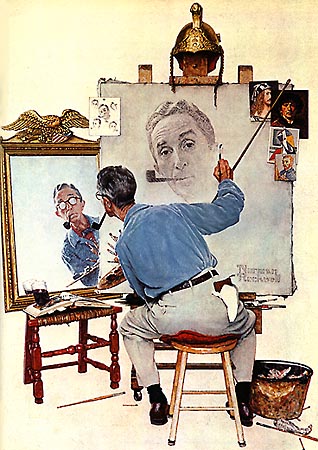
learning, visual style." Examples: from Seeing and Writing and
Rockwell's
self-portrait. A move beyond noticing involves referentiality--a
visual style of invention that works with place (Detroit) and the possibilities
of multiple naming systems for a single place. Folksono(me)--new media
taxonomy--supports multiple localized and individually designated meanings; tags
permit users to rename and redefine. Implications: self-referentiality
beyond detached noticing. Citing Barthes' RB, J. noted that the
reference can be thin; it "carries me back to somewhere in myself." The
folksonomic categories, therefore, overlap. They reciprocate, name him in
return. After introducing Ulmer's ideas about remakes and associative
dreamworks (where proof is replaced by the production of imaginary space), J.
brought up McLuhan's suggestion that new media produce anxiety. How to
respond to such anxieties? Selective entanglements: folksono(me) and
folksono(you) [This isn't quite the way J. put it...rough spots in my notes!].
With folksonomy, we find room for other reference systems and other
possibilities for a visual style expressed through strategic referentiality.
What do images want? Linkages. Throughout the talk, J. mixed in a
sequence of linkages--his own "multiple local meanings" in Detroit, at Wayne,
down Woodward Ave.
"The sweet, glamorous and deadly pink of screens: some perfections
of an online apparatus"
Anne's talk began with a pattern in looking at particular web sites: where are
the women? She framed her own research orientations in film studies, art
history and rhetoric. I experienced the talk as a buildup of histories of
seeing, apparatus theory and a variety of perspectival identifications--parts of
which A. aptly characterized as gendered. We might be more fully cognizant of
the structures supporting layout--the mechanisms that project the available ways
of seeing. A. clicked us through a few exemplary sites (a product listing
on Amazon, a Japanese anime site, and a project featuring reborn dolls).
Why aren't we more inquisitive toward mechanized layouts founded on
efficiency-drive? What kinds of seeing are encouraged (where body-images are
easily replaced)? How might site/interface design bring about more patient
browsing? A. brought in Virilio and Hayles; she reminded us that
photographic representation is crucial on the web, and, ultimately, her talk got
me thinking about the relationship of interfaces to differentiated
reading/browsing. If we don't pause to consider apparatus theory, we might
miss the otherwise transparent trajectories of interface design and web-viewing
experiences (visual, discrete, full, non-narrativized, isolated individuals, and
hard-surface of the screen) as they re-inscribe unmonitored patterns of
encountering the web.
Related links: Alex's thoughts and Jeff's note about the visit.
Tuesday, November 8, 2005
Assorted Like A Pack of Skittles
- Elbows out at SU: Somebody from the Laimbeer family is hooping for the Orange this winter.
- Tech Access Queue: Add this--the hundred dollar laptop--to the rare examples of folks doing more about access than invoking it as an angle of technology critique. I'll continue to log them when I run across a find, but they're infrequent. Raises tough questions of just how actionary access advocacy might be.
- We're Moving! Late-semestercide, but, well, it's time. We'll be closer to Ph.'s school and only a tiny distance farther away from mine. (Familial note: D.'s prepping an email with our new info. Looks like we might finally switch to 315 cell numbers, too.)
- I Feel a Sore Throat Coming On! For lunch, I'm strolling over to New Garden in Westcott and carrying home a gigantic hot-n-sour soup.
- All afternoon: spread out the Social Network Analysis stuff I'm putting together for Method~ologies. Do a little bit of mix and match on the kitchen table. Patterns?
- Collin and Jenny have posted photos from last week/end's symposium on digital and visual rhetorics. I was just thinking I ought to get my notes into blogable shape one of these days.
Monday, November 7, 2005
Bolter and Grusin - Remediation (1999) III
 In
the final section of Remediation, B&G break out three self orientations--three
varieties of self in light of the forceful processes of remediation: the
remediated self, the virtual self, and the networked self. The remediated
self basically begins with a notion of self as summative and re/configurable
(like William James' empirical self (233)) rather than rigid or authentic.
Remediated self gives way to (at least) two variations of self: immersed
and interrelated/interconnected. These selves correspond to the poles of
remediation; the immersed experiences the visually mediated as transparent and
immediate; the interrelated/interconnected self experiences the visually
mediated as opaque and navigable (232). According to B&G, we experience
ourselves in both ways. This connects up with expressive activity, too.
Virtual reality (where the user moves through) fits with romantic selfhood,
while opacity and ubiquitous computing are akin to the fixed-subject self of the
Enlightenment. The clearer part of this first chapter in section
three--"The Remediated Self"--builds on the duality of self as object and
subject in the specific case of bodybuilding. In bodybuilding, when "the
body is reconstructed to take on a new shape and identity," the body as medium
seems most plausible (237).
In
the final section of Remediation, B&G break out three self orientations--three
varieties of self in light of the forceful processes of remediation: the
remediated self, the virtual self, and the networked self. The remediated
self basically begins with a notion of self as summative and re/configurable
(like William James' empirical self (233)) rather than rigid or authentic.
Remediated self gives way to (at least) two variations of self: immersed
and interrelated/interconnected. These selves correspond to the poles of
remediation; the immersed experiences the visually mediated as transparent and
immediate; the interrelated/interconnected self experiences the visually
mediated as opaque and navigable (232). According to B&G, we experience
ourselves in both ways. This connects up with expressive activity, too.
Virtual reality (where the user moves through) fits with romantic selfhood,
while opacity and ubiquitous computing are akin to the fixed-subject self of the
Enlightenment. The clearer part of this first chapter in section
three--"The Remediated Self"--builds on the duality of self as object and
subject in the specific case of bodybuilding. In bodybuilding, when "the
body is reconstructed to take on a new shape and identity," the body as medium
seems most plausible (237).
The virtual self opens onto vast possibilities for perspectival free-play: "this same freedom can serve a more radical cultural purpose: to enable us to occupy the position, and therefore the point of view, of people or creatures different from ourselves" (245). The most optimistic response to this virtual freedom frames it as a way to reapportion point of view, ultimately fostering empathy (245). Jaron Lanier suggested more radical notions of empathy with the idea that VR users might move beyond human subjects to empathize with dinosaurs or even molecules (246). Of course, there are as many skeptics as proponents, but VR has sprung these questions to the fore, challenging us to sift through the implications of "perspective as a locus of all knowledge" (249). In the section, "The Dissolution of the Cartesian Ego," B&G hold VR up to Descartes' cogito and distrust of sensory experience (may as well trace this all the way to Sextus Empiricus and the Pyrrhonists...some of the earliest virtual-realists?).
Next chapter: "The Networked Self." Unlike the remediated self and the virtual self, which are forged through through the visual (?), the networked self is deliberately constructed out of felt connectivity among multiple and oftentimes simultenous points of view (257). The networked self is hypermediated because it is hypertextual. The examples in this section draw on MUD/MOO encounters--the encounters in multi-user online spaces (chat, etc.).
From the conclusion:1996 presidential campaign, Mars Surveyor landing, and Princess Dianna. "As we have shown, what is in fact new is the particular way in which each innovation rearranges and reconstitutes the meaning of earlier elements. What is new about new media is therefore also old and familiar: that they promise the new by remediating what has gone before" (270).
Terms: overwhelmed self (232), authentic self (233), William James' empirical self (233), operational degrees of freedom (244), adaptive interface (248), Cartesian perspectivalism (249), empathetic knowing (251), haptic feedback (252)
Figures: William James (233), Hayles (250), Descartes (250), Bourdieu (250), Lanier (251), Butler (264), Wittig (264)
"These virtual reality films take the process of empathetic learning
dangerously far--dangerous, that is, for the characters, who may find it
difficult to get their minds back into their original bodies" (247).
"Now, in the late twentieth century, no one in the virtual reality community can
share Descartes' distrust of the senses" (249).
"The crowding together of images, the insistence that everything that technology
can present must be presented one at a time--this is the logic of hypermediacy"
(269).
Sunday, November 6, 2005
Bolter and Grusin - Remediation (1999) II
Let's call this entry part two of three. I'm a bit behind (behind what? just my own schedule), but I'm through the application chapters--the middle 140 pages of B&G. In the paragraph opening into the final section, "Self," B&G write that these middle chapters are applications of remediation as a process. In their glossary, B&G define remediation this way:
remediation Defined by Paul Levenson as the "anthropotropic" process by which new media technologies improve upon or remedy prior technologies. We define the term differently, using it to mean the formal logic by which new media refashion prior media forms. Along with immediacy and hypermediacy, remediation is one of the three traits of our genealogy of new media. (273).
B&G discuss remediation as this logics-guided process involved with a variety of media throughout section two: computer games (88), digital photography (104), photorealistic graphics (114), digital art (132), film (146), virtual reality (160), mediated spaces (168), the www (196), and ubiquitous computing (212). In the final section, "Convergence," B&G offer an explanation for more various push-pull relationships among media. Whereas remediation tends to describe a uni-directional process of influence, convergences are akin to blends--multi-directional shapings felt among media (where television flows into the www and the www flows into television). Convergence rel. to remediation: a sloshing media spillway, a complex subversion of remediation's teleology.
The brief chapters in this section are useful as mini-histories for specific media, and they are also instructive for the way they set up the tensions between immediacy and hypermediacy, between realism and virtuality. However, because B&G's project is now 6+ years in circulation, I wondered how well remediation--as a description of one medium transitioning into another--holds up. It's clear that remediation happens; it's a valid description for the derivation and diffusion of logics. These logics, I suppose, draw together representation, technique, communication, instrumentation, and so on (this is an admittedly unruly list...wordwatchers, go on and ask what I mean by...it's a little bit loose, crumby). But remediation depends on resemblances; what happens when simple two-resemblance comparisons (x into y) become (-1-) so common and persistent as to be commonplace (pass into ubiquity?) or (-2-) so freestyle-frenetic as to exceed the analogic formulae for one media rolling pleasantly into another (breech the hyper, a hyper-hyper)?
Because remediation is processual, the short chapters on each medium also bring up questions about processual orthodoxies. Ever since looking at Sirc's En. Comp as a Happening this summer, I've been thinking about material and processual orthodoxies, esp. as reflected in composition (although S. is more explicitly concerned with the material). Such orthodoxies, artificially constructed as they may be, are useful even as plastic models good for introducing malleability to widespread practices (so widespread, I mean, as to be ingrained, rooted, reproduced smoothly and without hesitation). Remediation might simply point out the persistence of orthodoxies; to say something is remediated is as much a testament to its being constituted by antecedent parts/modes/models as it is an acknowledgement that change is inevitable (though not always deterministic).
The application chapters include a number of small points worth following up on: links between hypermedia and insanity/mania (154), digitality mocking photoreality (111), filmic games (98) and cinema of attractions--the public electrocution of an elephant (173). I'll also return to the section on mediated spaces; it was interesting to read the stuff on Auge and non-spaces following Jenny's talk on Friday about delocalization and a meta hodos of documentary. More on that, I hope, in another entry sometime soon. (We just lost electricity, so I'm finished.)
Terms: real as plenitude (119), vacillation (plate 8), digital art (133), absorption (147), Cinema of Attractions (155), fright/exhilaration (161), point-of-view technologies (162), virtual reality (166), flaneur (174), shared replicability (177), channel (188), ricocheting remediations (192), replicatory technology (201), augmented reality (215), telepresence (214), flow (as organic metaphor) (223)
Figures: Barthes and CL (110), Walt Disney (171), Marc Auge (177), Haraway, Anne Balsamo, Allucquere Rosanne Stone (182), Williams and McLuhan (185), Baudrillard (194)
"The process of digitizing the light that comes through the lens is no more
or less artificial than the chemical process of traditional photography" (110).
"Here as elsewhere, the logic of hypermediacy is to represent the desire for
transparent immediacy by sublimating it, by turning it into a fascination with a
medium" (122).
"Once it has been digitized, any image can undergo a while repertoire of
transformations, which for our culture are regarded as distortions: rotation,
shearing, morphing, and filtering (139).
"Virtual reality is also the medium that best expresses the contemporary
definition of the self as a roving point of view" (161).
"If artificial intelligence in the 1950s and 1960s refashioned the computer from
a mere adding machine into a processor of symbols, virtual reality is not
refashioning the computer into a processor of perceptions" (162).
"The television broadcast protocols have until now offered the viewer much less
visual information than a photograph or a film" (186). [Consider alongside
real/plenitude (119)]
Wednesday, November 2, 2005
Verbing Method
In 691 Method~ologies this morning, we re-traced some of the semester's where have we been: history, discourse analysis, ethnography and now theory. Obviously there's overlap aplenty--blends and interplays among these methodological orientations. In supershort form, history considers memory, record, retrospectives and recovery; discourse analysis works primarily with language and corpus (linguistic objects of study); ethnography notices people, culture and pattern/dynamics; and theory (small-t) accounts for a wide variety of stuff not limited to reading, writing, and thinking. Assemble, arrange, re-arrange, and answer curiosities, solve problems. No, these aren't my complete notes, and perhaps these few lines aren't very good as thin representations of ten weeks of work. There's a whole lot more to say here. But I wanted to raise a side question or two about method and methodology. When the subject of method~ology comes up, I'm increasingly tuned in to the part of speech invoked in the conversation. This has especially been the case with ethnography. The noun positions the method as a thing already done by others; it acknowledges a tradition and model projects against which we measure the edges defining the activity involved with doing ethnography. Is it like documentary? Must it feature human subjects? If we look to a set of nouned ethnographies (things, already-existing objects), then answering is possible. But the answer is set against a generic backdrop of the stuff already done. I don't know that we have a good verb for doing ethnography (ethnograph? ethnographize? um...no). The chosen term, however, has bearing. Consider the difference between using use the noun--ethnography--or the adjective--ethnographic--to account for the way of doing, ultimately the way of describing the research activity. And consider the verbs that we could collect under the broad (or is it narrow) rubric of ethnography: notice, observe, etc. What does this all come to? Well, I'm finding it more and more appealing to talk about methods as verbs, and I'm also wondering whether the methodology-as-noun departs from (or, on the other hand, refers to the same thing as) genre. Near enough as to be thought the same thing?
Program notes: The fall symposium on visual and digital rhetorics is happening on Thursday and Friday--two days of workshops and talks with Anne Wysocki, Jeff R., and Jenny E. What's not to look forward to?